
IE Business School
Giving students virtual access to a space they could not physically visit.
Where
Madrid & Segovia, with Telefónica & Nokia
Role
Concept and UX design
Product context
IE Business School needed to keep teaching and training running through the first year of the pandemic, in 2020, when everything that used to happen in person had to move online almost overnight.
Main challenges
Digitizing a real, protected historic building accurately enough to teach in, building soft-skills tools that felt true to life inside a headset, and getting all of it into students' and teachers' hands while campus itself was closed.
Digitizing the Claustro de Segovia
IE University's campus in Segovia includes the Claustro, a historic cloister the pandemic made physically impossible to visit. We scanned the whole space with photogrammetry, then retopologized the resulting mesh, since the raw scan was too heavy to run in real time.
On site, a set of Nokia phones synced over one of Telefónica's new 5G networks kept everything running together, so a professor of history, Miguel Larrañaga Zulueta, could guide students through the space in real time, pointing things out with a virtual laser as if it were a live museum tour.
Soft-skills training, in the middle of a pandemic
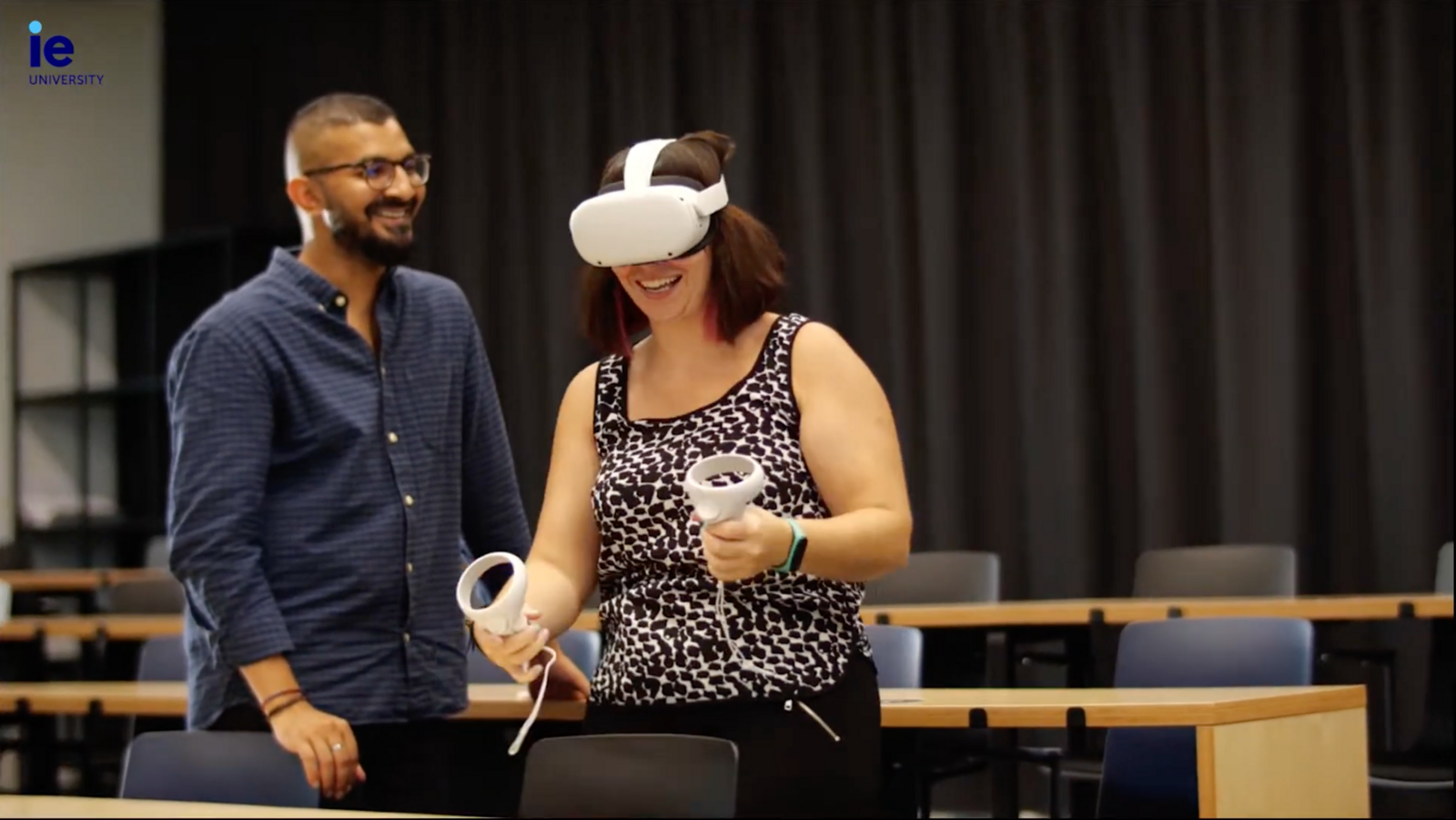
That same first year, every service that used to run in person had to move to a new, virtual format. I helped build several VR applications aimed at improving soft skills, for students and for teachers alike, among them Audience Simulator, a tool we kept adapting as we learned what worked.
Sharing headsets safely was its own challenge: some students were wary of the coronavirus, worried about catching it from equipment others had used. I also supported teachers directly, explaining how VR worked and which apps were worth trying with their classes, and briefed IE's staff on the social VR platforms available at the time, to help them decide which ones were worth a license.